Perfect Is Creepy: How Breaking Symmetry Breathes Life Into Your Character Sculpts
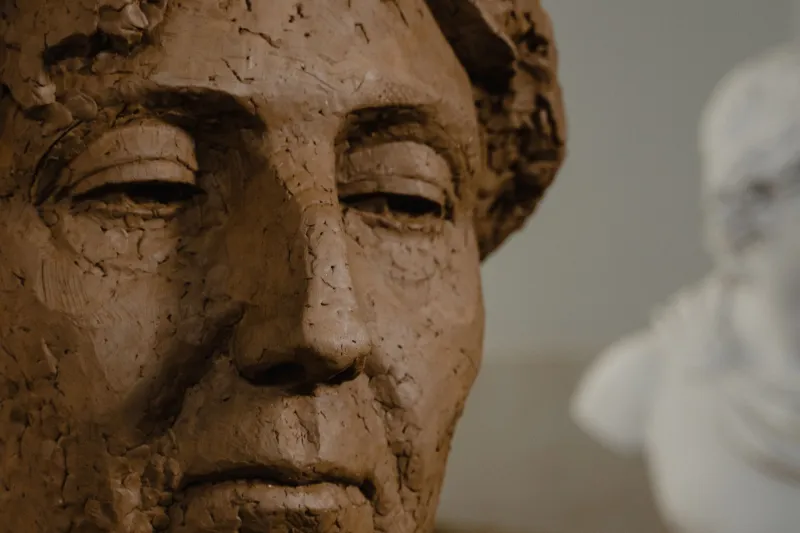
There's a moment every digital sculptor knows. You've spent hours on a character—tight topology, solid proportions, clean surface detail—and something still feels wrong. Not technically wrong. Just... off. Like you're looking at a face that's almost human but not quite human enough to trust.
Welcome to the symmetry trap.
It's one of the most common and least talked-about issues in character sculpting, and it doesn't show up on any topology checklist. It lives in the uncanny valley, that unsettling psychological space where near-perfect realism triggers discomfort instead of connection.
Why Your Brain Hates Perfect Faces
Here's the neuroscience, simplified: human faces are not symmetrical. Never have been. The left and right sides of a real face differ in subtle but measurable ways—one eye sits fractionally higher, one cheekbone pushes slightly further forward, the lip corner on one side pulls a little more when a person smiles. These micro-variations are so deeply embedded in how we read faces that when they're absent, our brains register something as wrong before we can even articulate why.
Researchers studying facial perception have found that perfectly symmetrical faces, while often rated as attractive in isolated studies, can simultaneously feel artificial, cold, or even unsettling in context. We're wired to look for the little inconsistencies that signal biological authenticity. When those signals aren't there, the brain fills in the gap with unease.
For digital sculptors working in ZBrush, Blender, or Mudbox, the symmetry brush is a godsend for blocking in forms efficiently. The problem is that too many artists never turn it off—and the result is a character whose face reads like a Rorschach test, identical on both sides, technically correct and emotionally hollow.
The Mirroring Habit and Where It Comes From
It's worth being honest about why symmetry is so tempting. It's faster. It's easier to maintain clean proportions when you're working both sides simultaneously. And for early-stage blocking, it's genuinely the right approach. No one is saying you should sculpt a human ear twice from scratch just on principle.
The issue is workflow inertia. Sculptors establish symmetry early and never revisit the decision. By the time the character is detailed and textured, breaking symmetry feels risky—like it might undo hours of careful work. So the mirrored geometry stays, and the character ends up in that unsettling no-man's-land between real and artificial.
Pro sculptors who work on film characters, game cinematics, and AAA hero assets all share a similar habit: they treat the symmetry phase as scaffolding, not a finished structure. The real character work happens after the mirror is off.
Techniques for Introducing Organic Imperfection
The good news is that asymmetry doesn't require rebuilding your sculpt from scratch. It requires intention and restraint—which is actually harder than technical skill, but very learnable.
Start with the eyes. Eye placement is where viewers spend the most time reading a face. Nudge one eye socket very slightly—a fraction of a millimeter in real-world scale—upward or forward. Don't go dramatic. You're not sculpting a character who's been in a bar fight; you're introducing the kind of natural drift that happens in every human face. Done correctly, viewers won't notice the change consciously. They'll just feel like the character is more real.
Work the mouth corners separately. One side of the mouth almost always sits at a slightly different angle than the other. This is especially important if your character has any kind of resting expression. A perfectly level mouth reads as neutral to the point of blankness. A mouth with one corner carrying just a hint of tension or lift suggests history, personality, inner life.
Vary the nasolabial folds. Those lines running from the nose to the corners of the mouth are among the most character-defining features on a human face, and they're almost never identical on both sides. One fold typically runs deeper or angles differently based on habitual expressions. This is where you can encode your character's backstory directly into the geometry.
Use the skin displacement layer for asymmetric surface noise. In ZBrush, adding a subtle layer of asymmetric surface variation—small pore clusters, micro-wrinkles, the faintest skin irregularities—does enormous work in selling biological realism. The key is that this layer should not be mirrored. Ever.
Don't forget the skull beneath the skin. Asymmetry isn't just a surface phenomenon. Real skulls have slight left-right differences that influence everything above them. If you're sculpting a character from scratch, consider introducing a subtle asymmetric quality at the base mesh level—a slightly wider zygomatic arch on one side, a jaw angle that doesn't quite match its mirror image. These foundational differences cascade naturally into every detail layer above.
The Before-and-After Reality
Sculptors who've made this shift describe the change in similar terms: they couldn't unsee it afterward. Looking back at their older, fully-symmetrical work, they notice the flatness, the magazine-cover sterility, the sense that the character is performing rather than existing.
The asymmetric version of the same character reads differently in lighting tests, too. Because the two halves of the face respond slightly differently to directional light, the character gains a sense of dimensionality and presence that no amount of surface texture alone can replicate. Cinematographers working in VFX have noted that asymmetric digital characters hold up far better in close-up shots precisely because they interact with light the way real faces do.
When to Break Symmetry (and When Not To)
This isn't a blanket endorsement of chaos. Stylized characters—cartoon heroes, mascots, anime-influenced designs—often use deliberate symmetry as part of their visual identity. Breaking symmetry in those contexts can undermine the design intent rather than enhance it.
But for any character that's meant to read as believably human, humanoid, or emotionally resonant? The symmetry needs to go before you call it done. The blocking phase is for mirrors. The character phase is for imperfection.
That slight unevenness in the brow. The jaw that doesn't quite close at the same angle on both sides. The ear that sits a hair lower than its twin. These aren't errors. They're the details that turn geometry into a person.
Turn off the symmetry brush. Do the work twice. Your characters will thank you for it.