Get Out of Your Own Way: How Letting Go Unlocks Your Best Sculpting Work
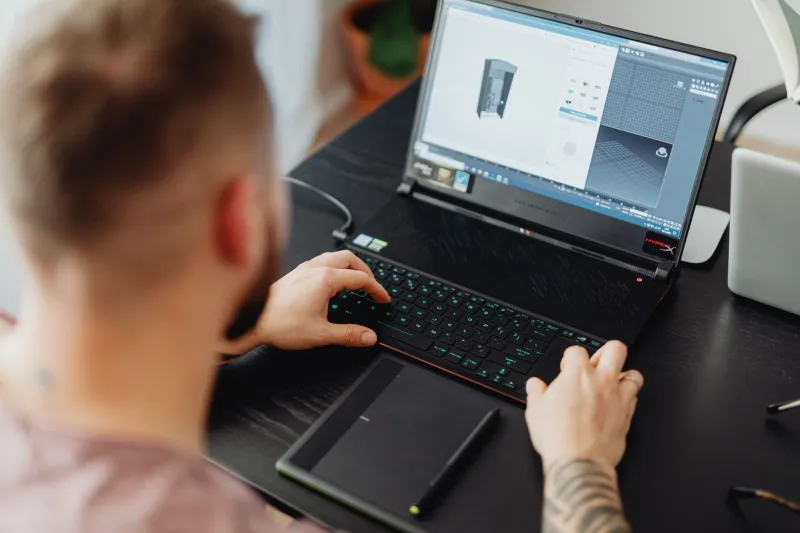
You've been staring at the same cheekbone for forty-five minutes. You've pushed it left, pulled it right, referenced seventeen anatomy photos, and somehow it looks worse than when you started. Sound familiar? That loop — that maddening, confidence-draining spiral — has a name. And the fix isn't another tutorial.
It's called creative paralysis, and it quietly sabotages more sculpts than bad topology ever could.
The Trap Hiding Inside Your Expertise
Here's the irony nobody talks about enough: the more you learn about 3D sculpting, the more opportunities you have to second-guess yourself. A beginner drops a sphere into ZBrush and just starts pushing clay around. They're not worried about anatomically correct zygomatic arches or whether their surface noise reads at render distance. They just make something.
Then you develop skill. You study anatomy, study light, study the masters. And suddenly your brain won't shut up. Every stroke comes with a committee meeting.
Psychologists call this "paralysis by analysis," and it's especially brutal in creative fields where there's no single correct answer. Unlike debugging code or solving a math problem, sculpting doesn't have a definitive right move — which means the analytical brain has infinite room to keep questioning.
Veteran character sculptor Marcus Delvane, who's shipped work for several major game studios, put it plainly in a community discussion thread: "The worst sculpts I've ever made were the ones I thought about the hardest. The best ones happened when I was tired, a little distracted, and just moving."
What Your Brain Is Actually Doing in Flow State
There's legitimate neuroscience backing this up, and it's worth understanding if you want to work with your brain instead of against it.
Flow state — that zone where time disappears and the work just happens — is characterized by reduced activity in the prefrontal cortex, the part of your brain responsible for self-monitoring and critical evaluation. Researchers call this transient hypofrontality. Essentially, your inner critic goes quiet, and the more intuitive, pattern-recognizing parts of your brain take the wheel.
For sculptors, this matters a lot. Your hands have memory. Your visual cortex has been trained by thousands of hours of observation. When you stop auditing every micro-decision, that accumulated knowledge flows through more freely — not less accurately.
The problem is that modern digital workflows are designed to keep you in your head. Undo history, symmetry toggles, reference image grids, layer stacks — all incredibly useful tools that can also become anxiety amplifiers when you're already in an overthinking spiral. Every safety net is also an invitation to second-guess.
Signals That You've Crossed Into Overthinking Territory
Before you can fix it, you have to catch it happening. A few telltale signs:
- You're referencing more than you're sculpting. Reference is essential, but if you're Alt-Tabbing every thirty seconds, you've stopped trusting your eye.
- Everything looks fine from a distance but you keep zooming in. The macro is working. You're hunting micro-problems that don't affect the read.
- You've undone the same stroke five times. Not because it was wrong — because you're not sure if it was right.
- You've been "almost done" for two hours. Finishing feels dangerous because finished can be judged.
That last one is worth sitting with. A lot of perfectionism isn't really about quality — it's about avoiding the vulnerability of completion.
Practical Ways to Break the Loop
Set a stroke budget. This sounds rigid, but it works. Give yourself a fixed number of strokes to address a specific area, then move on. Scarcity forces commitment and trains you to trust your first instinct more.
Work big, then walk away. Spend thirty minutes sculpting at a zoom level where you can see the full figure or face. No zooming in. Then close your laptop and come back the next day. Fresh eyes cut through the noise of accumulated micro-decisions.
Use a timer, not a to-do list. Instead of a checklist of things to fix, work in timed blocks — say, twenty-five minutes of pure sculpting with no evaluation allowed. When the timer goes off, then you assess. This is basically the Pomodoro technique adapted for creative work, and it's surprisingly effective at keeping the critic in its lane.
Sculpt with music that has no lyrics. This isn't just vibe advice. Verbal processing and spatial/visual processing share cognitive resources. Instrumental music — particularly anything with a consistent rhythm — keeps the verbal, analytical brain occupied without hijacking your visual focus.
Kill symmetry for a session. Working asymmetrically forces you to make judgment calls constantly and quickly. There's no mirrored safety net, so you stop agonizing and start committing. Many sculptors report that their asymmetry sessions produce their most dynamic, alive-feeling work, even if they re-enable symmetry afterward.
The Professional Mindset Shift That Actually Sticks
Here's what separates working professionals from perpetual students in the 3D space: pros have learned to distinguish between productive critical thinking and unproductive rumination.
Productive: "This silhouette isn't reading correctly at thumbnail size. I need to push the gesture."
Unproductive: "Is this ear right? Let me check five more references. Actually, is the ear even the problem? Maybe it's the jaw. Or the lighting."
The first leads somewhere. The second is just anxiety wearing the costume of diligence.
Developing that distinction takes time, but a useful shortcut is asking yourself: am I solving a specific problem, or am I looking for reassurance? If it's the latter, no amount of analyzing will actually help. The only move is to make a decision and keep going.
Freelance sculptor and online educator Priya Nanthan has a rule she shares with her students: "If you've looked at the same area for more than ten minutes without making a change, you've stopped sculpting and started worrying. Make any change — even a bad one — and see what it tells you."
That reframe — treating a "wrong" stroke as information rather than failure — is quietly transformative. Mistakes become data. Data moves you forward. Paralysis doesn't.
Trust What You've Built
Every hour you've spent studying anatomy, watching breakdowns, doing speed sculpts, grinding through anatomy studies — that work isn't wasted when you stop consciously referencing it. It's stored. The whole point of deliberate practice is that it eventually becomes intuition.
When you let go and sculpt from feel, you're not abandoning your training. You're finally letting it run.
The artists whose work stops you mid-scroll — the ones whose characters feel alive, whose creatures feel like they could breathe — they're not thinking less than you. They've just learned to think at the right times. During planning. During critique. During study.
Not during the sculpt.
Get out of your own way. The work's been waiting.